
Composable Architecture vs Microservices: What's the Difference?
Composable vs microservices: one is a buy-or-build call for the business. The other is how one system gets split into pieces.
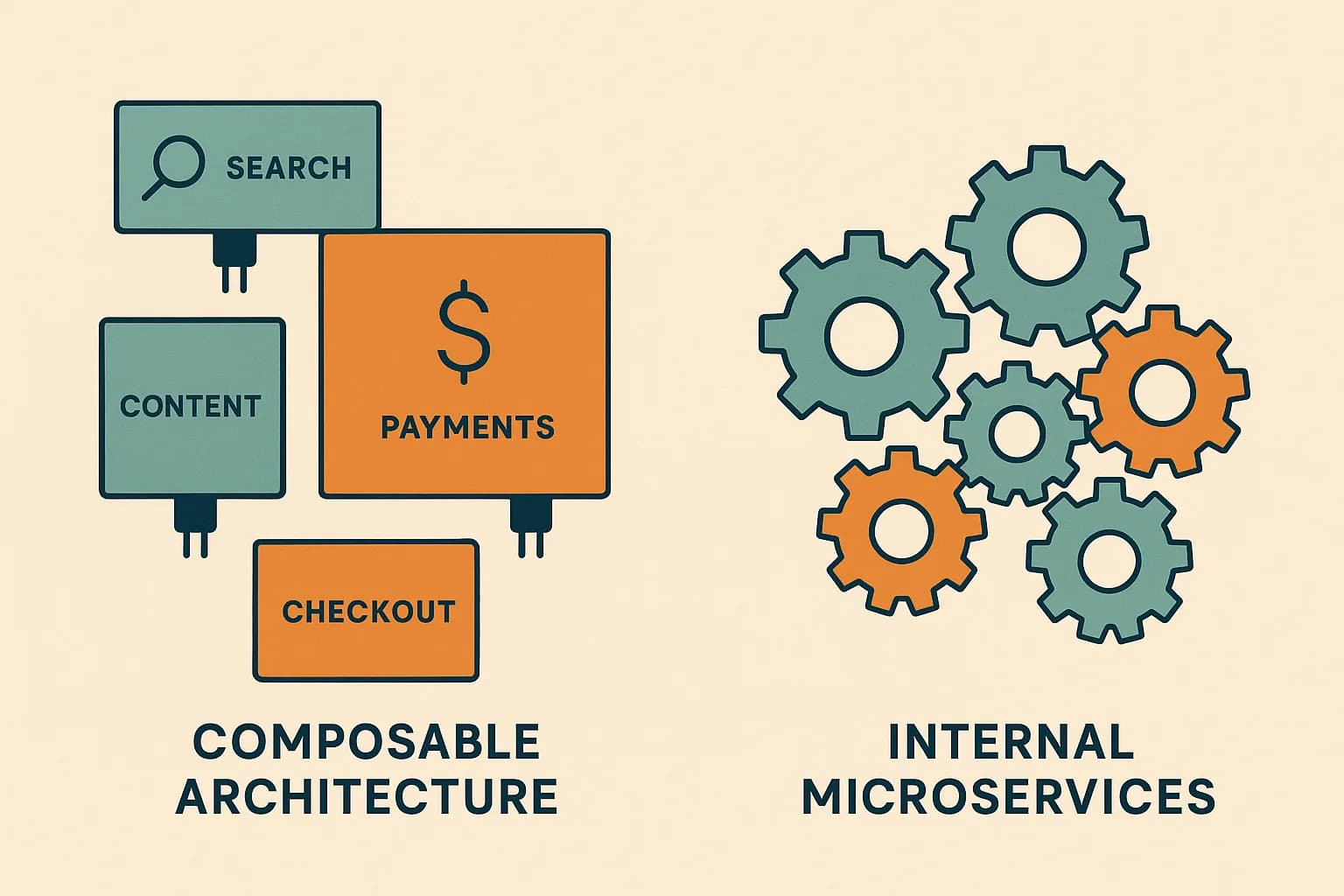
Composable architecture and microservices are not competing choices. Microservices is a technical pattern. An app gets split into small, independently deployable services. Composable architecture is a business-capability boundary instead. You pick best-of-breed services (commerce, search, content, auth) and wire them together over APIs, whether you built them or bought them. Most teams that go composable already run some microservices under the hood. The mix-up comes from treating one as a replacement for the other, when one is usually built out of the other.
Neither term is new on its own. What's new is how often they get used interchangeably in vendor marketing. That flattens a real distinction, one that matters once you're deciding what to build versus what to buy.
What composable architecture actually means
A composable stack breaks a platform into independent, replaceable pieces, each owning one business capability. Draftbase's own guide on composable architecture covers the full MACH framing: Microservices, API-first, Cloud-native, Headless. A content layer, a search index, a payments processor, and a checkout flow can each come from a different vendor. The business swaps any one of them without rewriting the rest.
The unit of decision is a capability, not a service boundary. "We need product search" is a composable decision. "This service handles the search index and that one handles ranking" is a microservices decision made once you've picked, or built, the search piece.
A useful test: could a non-technical stakeholder describe the decision without naming a technology? "We're replacing our search vendor" is composable talk. "We're splitting the search service from the ranking service" is microservices talk. That's true even if both sentences describe the same piece of software.
What microservices actually means
Microservices is an implementation pattern for a single system. A monolith gets split into small services, each with its own codebase, deployment, and datastore. Those services talk to each other over a network. A team building an online store backend from scratch might split it into an inventory service, an order service, and a pricing service. All three stay one company's own system.
Nothing here requires buying from multiple vendors. A single team can run a fully microservices-based backend that's still one monolithic product from the customer's perspective. That's the core distinction. Microservices describes how one system is built internally. Composable describes how a business assembles multiple systems, whether those systems are internal services or paid vendor products.
How to tell them apart in practice
Ask two questions about any given piece of the stack. First: who owns the decision to change it, an engineering team or the business? Second: does replacing it mean swapping a vendor, or rewriting internal code? A piece that only engineering can touch, where "replacing" means a rewrite, is a microservice in the plain sense. A piece the business can swap by signing a different contract, with the surrounding system unaffected, is a composable capability.
Most real stacks have both kinds of pieces side by side. A payments processor is almost always composable, since no company builds its own from scratch. An internal recommendation engine tuned to one company's catalog is almost always microservices only, since there's no vendor equivalent to swap in. Treating every piece the same way is the mistake. Assume everything should be swappable, and teams overspend on abstraction they don't need. Assume nothing should be, and they underinvest in the API boundaries they do need.
Where the two overlap
The overlap is real, and it's why the terms get conflated. The MACH Alliance's own principles list microservices as one of four pillars of a composable stack, alongside API-first, cloud-native, and headless. Most vendor-built composable services (a headless CMS, a composable commerce platform) are themselves built as microservices internally. So when a business goes composable, it's often buying a set of vendor products, each one built as microservices. The business then integrates them at the capability layer, not the code layer.
The reverse doesn't hold. A company running microservices internally isn't automatically composable. Not if every one of those services is homegrown, and none of them are swappable for a vendor alternative. Composability requires the capability boundary to be real enough that you could replace a piece without replacing the business logic around it. A microservices split that only your own team can see through the API contract isn't composable. It's just well-organized internal code, which is worth doing on its own merits, but it's a different goal.
Why this distinction matters for AI adoption
The MACH Alliance's February 2026 Enterprise Technology Report surveyed 600 enterprise technology decision-makers across seven markets. It found 78% of companies with mature composable technology report clear AI ROI. Only 13% of companies with no composable adoption say the same. The gap tracks a specific mechanic. An AI agent that needs to read product data, check inventory, and place an order needs each one as a clean, independently callable API. A monolith with microservices bolted on internally doesn't expose that boundary externally. A genuinely composable stack does, because the API-first pillar is a hard requirement, not an implementation detail.
That's a different argument than "microservices are faster to build." It's an argument about who else, or what else, can call your system. An AI agent is just another caller.
When microservices alone is the wrong lens
A team building a single product from scratch doesn't need to think in composable terms at all. Say nothing in the stack will ever be swapped for a vendor alternative. Say no outside caller, human or AI agent, needs to hit any piece independently. Then microservices is purely an internal engineering decision: does splitting the codebase buy you deployment or scaling wins worth the operational cost? That calculus has nothing to do with composability. Treating every microservices project as a step toward "going composable" adds vocabulary without adding value.
Getting started with a composable content layer
A headless CMS is usually the first composable piece a team adopts. Content is the capability most teams already buy rather than build. Draftbase fits the API-first pillar directly. It ships REST and GraphQL delivery, plus a management API kept apart from the read-only delivery API. Content is MDX-based, so it doesn't lock a frontend to one rendering approach. Swapping the content layer later is the whole point of starting composable instead of monolithic. So is adding a search or commerce piece next to it.
| Option | Verdict | Pros | Cons |
|---|---|---|---|
| Composable Architecture | The right lens when a capability should be swappable for a vendor alternative without rewriting the business logic around it. |
|
|
| Microservices | The right lens for splitting a single system's own codebase, regardless of whether any piece is ever bought from a vendor. |
|
|
Ship content that's built to be found
Draftbase generates schema, structured data, and a fast MDX editor for every post.
Frequently asked questions
Is composable architecture just microservices with a new name?
No. Microservices is how one system gets split into parts internally. Composable is a business decision to buy swappable services instead of building everything in-house.
Do I need microservices to be composable?
Not directly, but in practice yes. Most vendor products sold as composable are built as microservices internally. You buy the capability; the vendor handles the internal split.
Can a company run microservices without being composable?
Yes. A homegrown microservices backend where nothing is swappable for a vendor product is well-organized internal code. It is not a composable stack.
Why does composable architecture matter for AI agents?
An AI agent needs each business capability, like inventory or search, as a clean, callable API. A composable stack exposes that by design. A monolith with internal microservices often does not.
Should a small team bother with composable architecture?
Only where a piece is genuinely worth buying instead of building, like content or payments. For a single homegrown product with no outside vendor swap in play, plain microservices is enough.
Working with this hands-on? Draftbase also has a free supabase rls checker.