
Content as a Service (CaaS) vs Backend as a Service (BaaS)
Content as a Service (CaaS) delivers content over an API. Backend as a Service (BaaS) bundles a full app backend. See the real difference and when to use each.
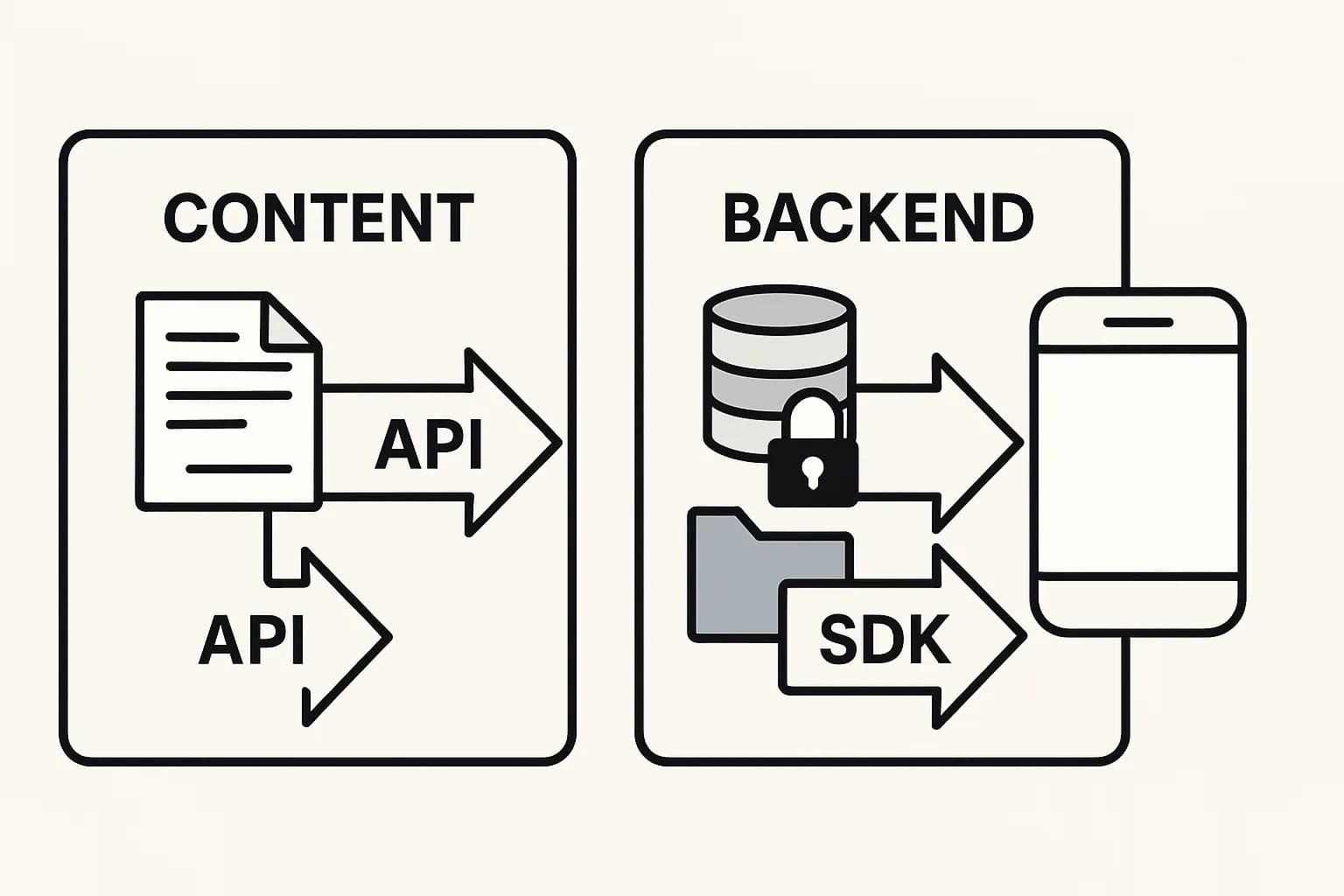
Content as a Service (CaaS) delivers content over an API. It stays decoupled from any front end. Backend as a Service (BaaS) bundles a full app backend behind one SDK. Auth, database, storage, functions. The two solve different problems. CaaS is the content half of a stack. BaaS is the whole stack. A modern app often uses both at once. Mixing them up leads teams to pick the wrong tool for the job.
Search "CaaS" and most results mean something else. They mean Containers as a Service, a model close to Kubernetes. That's a real name clash, and it matters here. Most "CaaS" content on the web won't answer the question a content team actually has. This guide is about Content as a Service. It's the model behind headless CMS platforms like Draftbase. It is not about container orchestration.
What Is Content as a Service?
Content as a Service is a delivery model. A vendor stores your content and its structure. It serves that content through an API, not by rendering pages itself. The term comes from the same "as a service" family as SaaS and PaaS. Instead of installing and running a system yourself, you consume it as a hosted service. Contentful describes CaaS this way: vendors that focus only on content. Not on frontend design. An all-in-one system is different. It ties backend admin to frontend rendering in one product.
A headless CMS is a CaaS product. Content lives in structured fields: title, body, images, references. Any front end pulls it via REST or GraphQL. The CMS never touches HTML, CSS, or a rendering pipeline. That work stays with whatever app calls the API. Draftbase's delivery API works this way. Entries come back as JSON, with MDX content ready to compile client-side.
What Is Backend as a Service?
Backend as a Service covers the whole app backend, not just content. A BaaS platform runs login and auth. Plus a database, file storage, serverless functions, and often push alerts. All of it is reachable through client SDKs, not raw infrastructure. Firebase and Supabase are the two most cited examples. Point a mobile or web app at the SDK, and skip setting up a server yourself.
A headless CMS models content: blog posts, product descriptions, marketing pages. A BaaS models application data instead. User accounts, orders, chat messages. Anything an app reads and writes as part of its own logic. Some BaaS platforms let you define arbitrary tables and treat them like a flexible database. That's powerful, but it isn't a content model built for editors. Revisions, scheduled publishing, a plain editing UI. Rarely first-class in a BaaS admin panel.
CaaS vs BaaS: The Core Difference
| CaaS (headless CMS) | BaaS | |
|---|---|---|
| Primary purpose | Store and deliver content | Run app-level backend logic |
| Typical consumer | Marketing site, blog, docs | Mobile app, SaaS product |
| Core primitives | Content types, fields, revisions, publishing | Auth, database, storage, functions |
| Who edits it | Content editors, marketers | Developers, end users (via the app) |
| API shape | Read-heavy delivery API, some write for authoring | Full CRUD, real-time sync |
Here's a practical test. Does the thing being stored have an editor and a publish button? If so, it's content, and CaaS fits. Is it user-generated data an app reads and writes as part of its own workflow? Then it's backend state, and BaaS fits. A product listing an editor writes and schedules is CaaS. The cart that references that product is BaaS.
Where the Two Overlap
Some platforms blur the line on purpose. Supabase ships a Postgres database with a built-in REST API. It can store a blog's content too, the way any database can. But the difference is what's built around the storage. A CMS ships an editing workflow: drafts, scheduled publishing, revisions, roles for non-technical editors. A BaaS ships app-building basics instead: auth, live updates, row-level security. Storing content in Supabase works. You'd just build the editing layer yourself.
The reverse also happens. A headless CMS with webhooks and a management API can trigger app-side logic on content changes. Publish a post, fire a webhook, update a search index. That doesn't turn the CMS into a BaaS. It just means the CMS's API taps the same pattern a BaaS uses for its own functions.
A real app frequently needs both. Draftbase (or another headless CMS) handles the site's content. A BaaS or custom backend handles user accounts, orders, and anything the app itself generates at runtime. Treating one as a substitute for the other is where teams get stuck. Either they force editing steps into a database table. Or they bolt a CMS onto data it was never built to hold.
What Breaks When You Use the Wrong One
Storing content in a BaaS database usually starts fine. A table for blog posts, a few columns, done. The pain shows up later. There's no draft/published state without building one. There's no scheduled publishing without a cron job and custom logic. A marketer wants to preview an unpublished change. Now someone has to build an admin screen just for that. None of this is impossible in a BaaS. It's just work a CMS ships on day one.
The reverse mistake shows up differently. Teams try to fit live app state into a CMS. A shopping cart, a chat thread. That's not what a CMS is built for. Every write goes through a content-review mindset: drafts, revisions, publish gates. That's friction a cart update doesn't want. A cart change needs to persist instantly, not wait on a publish step. Real-time sync is the kind a chat feature needs. A content delivery API isn't built for that either.
The fix isn't picking one platform and forcing everything through it. Match each kind of data to the model that already fits its shape. Content through CaaS. App state through BaaS.
When to Choose CaaS
Pick a headless CMS when non-technical people need to write and publish content. Pick it when the same content has to reach more than one channel: web, app, marketing emails. Pick it when publishing needs review states, scheduling, and rollback. A marketing site, a blog, a docs portal. A multi-brand content hub too. All classic CaaS use cases. The API-first delivery model also means the front end can be rebuilt. A new framework, a full redesign, neither touches the content itself.
When to Choose BaaS
Pick a BaaS when the app needs its own live, changing state. Think user accounts, sessions, orders, chat history. Anything created by end users, not editors. BaaS platforms also win when you need real-time sync, like live cursors, chat, or presence. The same goes for a database schema that changes as fast as the product does. A content-review layer would only slow those writes down.
Frequently Confused: Is CaaS the Same as Headless CMS?
Yes, in practice. "Content as a Service" is the delivery model. "Headless CMS" is the product category that implements it. Every headless CMS is a CaaS platform. Not every CaaS mention on the web is about content, though. A search for "CaaS" often returns Kubernetes and container-hosting results instead. That's the name clash with Containers as a Service at work. If a page starts talking about Docker or pod scheduling, it's the wrong CaaS.
Conclusion
CaaS and BaaS both let you skip building infrastructure from scratch. They just abstract different halves of an application. CaaS hands you a content model. Plus an editing flow and a delivery API for anything an editor writes. BaaS hands you auth, a database, and functions for anything an app generates on its own. Most real products need a version of both. A headless CMS like Draftbase for the content side. Whatever backend handles user data for the rest. Is the content side the part slowing your team down? See Draftbase's pricing and delivery API. Check how it fits into that stack.
Ship content that's built to be found
Draftbase generates schema, structured data, and a fast MDX editor for every post.
Frequently asked questions
Is CaaS the same as a headless CMS?
Yes. A headless CMS is a Content as a Service product. It stores content and serves it through an API, with no front end of its own.
What is the main difference between CaaS and BaaS?
CaaS delivers editorial content through an API. BaaS bundles a full app backend, like auth and a database, behind an SDK. One handles what an editor writes. The other handles what an app generates.
Can I use CaaS and BaaS together?
Yes, and most real apps do. A headless CMS like Draftbase serves the site's content. A BaaS or custom backend handles user accounts and app data.
Does "CaaS" always mean Content as a Service?
No. Containers as a Service uses the same acronym. If a result talks about Docker or Kubernetes, it means the container model, not content delivery.
Is Firebase a CaaS or a BaaS?
Firebase is a BaaS. It bundles auth, a database, storage, and functions behind one SDK, built for app data rather than editorial content.
Working with this hands-on? Draftbase also has a free supabase rls checker.