
Human Approval Workflows for AI-Generated Content
Human approval workflows let AI draft and edit content, but only a person can publish it. See why that gate matters and how to build one.
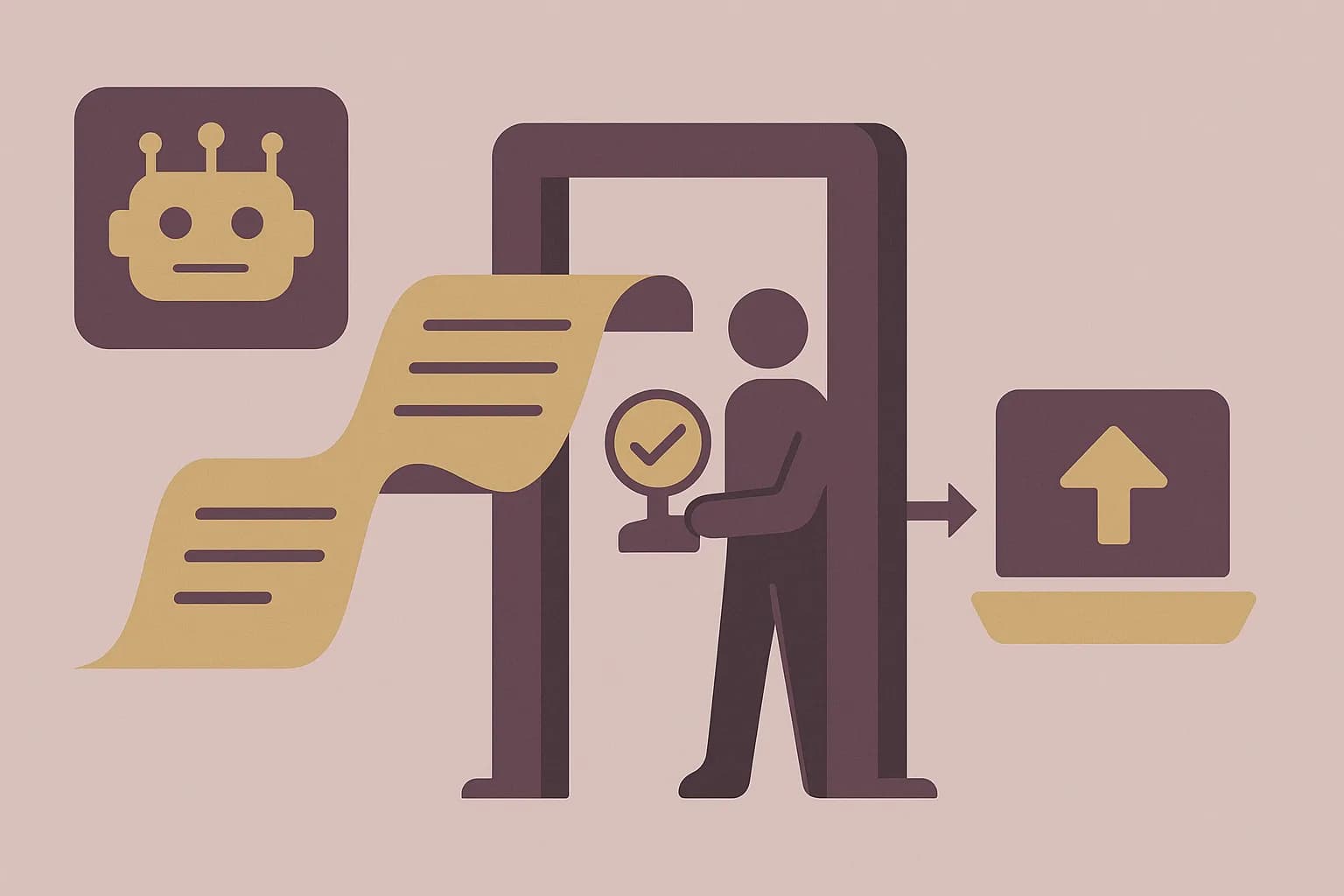
A human approval workflow for AI-generated content is a required review gate between an AI draft and anything a reader sees. It's usually four states: draft, review, approved, published, with a named person signing off before the last one. The gate matters more than the review itself. An AI agent that can write a draft but not flip it to published can't do damage alone, no matter how confident or wrong that draft is.
That's the whole idea, and most teams get it half right. They review AI content. They just don't block the AI from publishing it directly, so the review becomes optional in practice. See how to let an AI agent edit content in your CMS for the agent side of this. This page covers the gate itself.
Why Can't AI Just Publish Directly?
Because an AI agent has no way to know when it's wrong. A model can hallucinate a fact or misread a brief. It can also follow a prompt-injected instruction hidden in a tool description (OWASP on MCP tool poisoning). Either way, it states the result with the same confidence as something true. A human reviewer catches what the model can't flag about itself.
Regulators have started to require this explicitly, not just recommend it. The EU AI Act's Article 14 mandates human oversight for high-risk AI systems, with enforcement active through 2026. Systems must be designed so a person can effectively monitor and intervene in their operation (EU AI Act Article 14). Content publishing usually isn't classified high-risk on its own. The design principle still transfers directly: build the off-ramp before you need it, not after.
What Does the Draft → Review → Publish Gate Actually Look Like?
Four states, one gate. Draft: the AI or a person creates or edits an entry; nothing changes on the live site yet. Review: a named person reads the draft against a checklist, not a vibe check. Approved: review passed; the entry is queued but still unpublished. Published: the only state a reader can see.
The gate is the transition from approved to published, and it has one hard rule: an automated process can move content into draft, review, or approved. Only a human action publishes it. Every mature editorial workflow already works this way for human writers (Knack on AI content approval workflows). Adding an AI writer to the front of the pipe doesn't change the gate. It just changes who sits in the draft state more often.
Route by risk, not by source
Not every draft needs the same scrutiny. A typo fix and a pricing page rewrite shouldn't sit in the same queue with the same priority. Route by what the content touches — pricing, legal, medical, or financial claims get mandatory senior review; a blog post's second paragraph doesn't. Some teams route by a model's own confidence score, auto-flagging low-confidence output for a closer look and fast-tracking high-confidence output through a lighter check. That keeps reviewer attention on judgment calls instead of mechanical checks a script could run anyway.
How Do Revisions Fit Into This?
A revision history is what makes the gate auditable instead of just theoretical. Every edit — AI or human — should leave a record: who changed what, when, and what the entry looked like before. Without that, "a human approved this" is an unverifiable claim.
Draftbase keeps a full revision history per entry, with rollback to any prior version. The set_entry_status and batch_set_entry_status MCP tools move an entry through draft, review, and approved, and each call is logged the same way a human edit is. An AI agent connected over MCP can create and edit entries, but publishing is a separate, explicit action. The agent can get a draft to "approved," not past it. That split is structural, not a policy a prompt could talk the model out of.
What Breaks Without This Gate?
The failure mode isn't dramatic. It's a wrong price, a broken claim, or a factual error that goes live because nobody was the last checkpoint before "published." The fix teams reach for after the fact is "we'll just review AI output more carefully." That doesn't hold. It depends on a human remembering to check every time, with no structural backstop when they don't.
The fix that holds is removing the AI's ability to publish at all. The safest place for AI-generated content is somewhere it structurally cannot reach production without a person deciding it should (Glean on AI content review). That's a build decision, not a training decision — no amount of prompt engineering substitutes for a system that makes the wrong path impossible instead of merely discouraged.
The Underused Angle: the Gate Is a Feature of the CMS, Not the Prompt
Most guides to this problem talk about prompting the AI to be careful. Add a "please review before publishing" instruction, they say, or train a reviewer checklist. That's process built on hope. A prompt is a suggestion a model can miscount, misread, or ignore under the wrong input.
The gate that actually holds lives in the content platform. That means separate write and publish permissions. It means a status field the AI can't skip past. It means a delivery API that only ever serves published content, even when an internal draft looks finished. Ask what your CMS enforces structurally before you ask what your prompts say. A model that technically has a publish tool available will eventually be told, correctly or through injection, to use it.
Conclusion
A human approval workflow isn't a review step bolted onto AI content. It's a state machine — draft, review, approved, published — where only a human action crosses the last line, backed by a revision history that makes every step auditable. Draftbase's MCP server gives an AI agent full read/write access to draft content and zero ability to publish it. The delivery API a live site calls only ever returns published and updated entries. It never returns a pending edit, no matter how that edit was made. See pricing to try the gate yourself, or read how MCP clients and servers work together for the connection mechanics underneath it.
Ship content that's built to be found
Draftbase generates schema, structured data, and a fast MDX editor for every post.
Frequently asked questions
What is a human approval workflow for AI content?
A required review gate between an AI draft and publication. Content moves through draft, review, and approved states. Only a human action moves it to published.
Can AI-generated content publish itself?
It shouldn't be able to. The safest setup gives an AI agent full access to draft and edit content. It gets no access to the publish action itself.
Does the EU AI Act require human review of AI content?
Article 14 requires human oversight for high-risk AI systems, with enforcement active in 2026. Most content publishing isn't classified high-risk. The same design principle still applies: build a human checkpoint before content goes live.
How do you scale human review without a bottleneck?
Route by risk, not by source. Pricing, legal, and factual claims get mandatory review. Routine copy gets a lighter check, sometimes triggered by a model's own confidence score.
Why do revisions matter for AI content approval?
A revision history makes the approval gate auditable. Without a record of who changed what and when, "a human approved this" is a claim you can't verify.
Working with this hands-on? Draftbase also has a free mcp inspector.