GitHub vs GitLab: Key Differences for Dev Teams
GitHub vs GitLab compared on CI/CD, AI assistants, pricing, and self-hosting. See which platform fits your team, and what neither one solves.
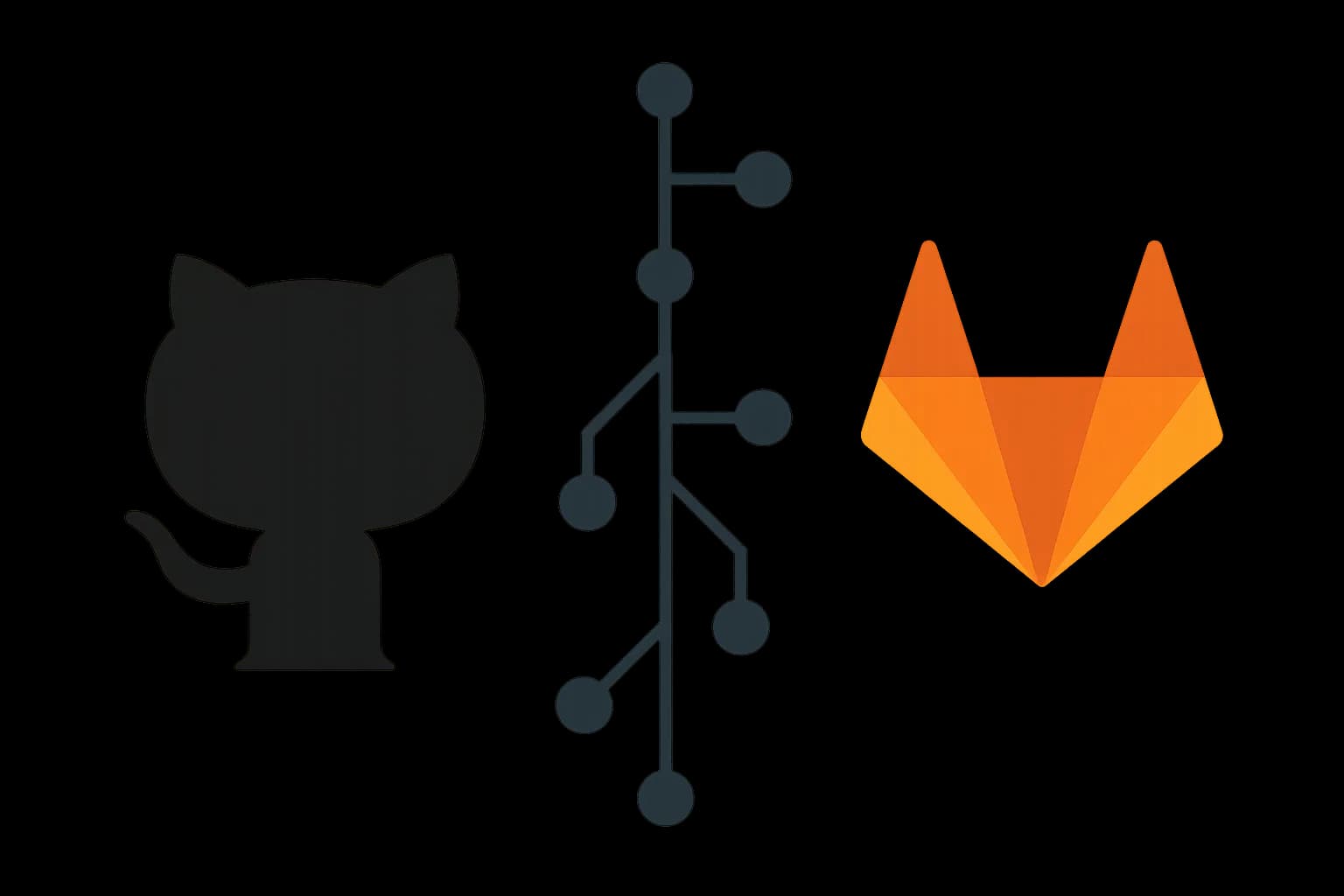
GitHub is parts, GitLab is a kit. Pick GitHub for reach, add-on choice, and public per-seat pricing. Pick GitLab for one joined-up tool chain, audit features, and self-hosting.
GitHub and GitLab are the two version control systems most dev teams reach for once they outgrow plain Git. Both host Git repos, run CI, and review code. The difference is scope. GitHub is a coding platform with a huge market of add-ons around it. GitLab is one DevOps platform that ships most of the tool chain in the box.
That split decides most of these choices. GitHub still hosts the bulk of public open-source work, near 80% of that market, with 180 million signed-up developers as of late 2025. (Spacelift) GitLab trades that reach for one joined-up system.
What Is the Core Difference?
Think of it as parts versus a kit.
GitHub gives you strong basics and a market to fill the gaps. Security scans, issue tracking, and deploys often come from other tools you wire in. Any piece can be swapped out.
GitLab ships source control, GitLab CI/CD, a container registry, security scans, and audit dashboards as one product. Fewer add-ons to maintain. Fewer tabs to switch between. (Spacelift)
Neither is better in the abstract. One aims at choice. The other aims at fit.
Ask which annoys your team more. Wiring five tools together, or living inside one vendor's view of every stage.
How Do the CI/CD Systems Compare?
Both are mature. They rest on different bets.
GitHub Actions launched in 2018 and grew on a build-from-parts design. (Spacelift) The Marketplace is the real asset here. Most things you want to automate already have an action someone else maintains.
GitLab CI is joined up rather than assembled. Pipelines, registry, and scans share one data model. A security finding links to the pipeline and the commit that caused it.
The gap shows up when things break. GitHub gives you more blocks and more seams. GitLab gives you fewer seams and less room to stray.
Is your pipeline standard? GitLab's defaults save real setup time. Is it odd in some way? GitHub's mix-and-match parts are worth more.
Which Has the Better AI Assistant?
This is where a 2026 comparison differs from a 2023 one. Most roundups still miss it.
The usual framing is a feature race. Copilot has a one-million-token context window in VS Code, the CLI, and the Copilot app. (Spacelift) Duo's Agent Platform went generally available in January 2026, with multi-agent flows and event-driven runs.
But the real gap is the data, not the model.
Duo runs inside GitLab's data model. Its answers can draw on CI/CD context, security findings, and deploy history, because all of it lives in one place. (Spacelift)
Copilot cannot do that out of the box. On a typical GitHub setup, those sources sit in other tools.
So change the question you ask in a demo. Not "how big is the context window." Ask what the assistant can see.
An assistant that reads your code is normal now. One that also reads why last Thursday's deploy failed is a different product. How much that helps depends on how much of your stack sits in one place.
What Do They Cost?
GitHub lists its prices in public, and both platforms keep a free tier for small teams and public repos. Team is reported at $4 per user per month, and GitHub Enterprise at $21. (Costbench)
GitLab list pricing has been reported at $29 per user per month for Premium, and $99 for Ultimate, billed yearly. (Costbench)
There is a catch worth naming. Since June 2026, GitLab no longer shows a fixed Premium price. It shows "Let's talk" instead. Ultimate has needed a custom quote for years.
Budget for that, and not just in money. A quote-only tier means sales calls before you can even compare.
Compare the bundles too. GitLab Ultimate folds in scanning and audit features that cost extra on GitHub through other vendors. A per-seat number on its own will mislead you.
What About Self-Hosting?
This is often the row that ends the debate.
GitLab has run a self-managed edition for years, and it is a first-class path rather than an afterthought. Teams under data-residency rules or air-gapped networks lean here for that reason alone.
GitHub offers a self-hosted server product too. It sits at the enterprise tier and is priced for it.
Both also sell fully hosted options if self-hosting is not a requirement, which is the default choice for most teams under a few hundred seats.
The honest note is that self-hosting is never free. You take on upgrades, backups, and the pager. Run it only when a rule forces you, or when the scale math truly works out.
Which Should Your Team Pick?
| Situation | Better fit |
|---|---|
| Open source, contributor reach matters | GitHub |
| Regulated work, audit dashboards needed | GitLab |
| Leans on many third-party tools | GitHub |
| Wants one vendor for the whole tool chain | GitLab |
| Self-hosting is a hard rule | GitLab |
| Lowest possible per-seat cost | GitHub |
Two rows usually settle it. Must you self-host, and is audit reporting a rule or a nice-to-have?
Open source projects should weigh reach. Contributors already have GitHub logins. Asking them for a new one costs you drive-by fixes.
Team habit counts as well. A tool your team already knows beats a slightly better one they have to learn, at least for the first year.
How Do They Handle Issues and Planning?
Both track issues, feature requests, and bugs. The depth differs a lot.
GitHub Issues is deliberately simple. Labels, milestones, and Projects boards cover most of it. Teams that want more reach for Linear, Jira, or Shortcut and wire them in as their project management tool of choice.
That is the GitHub pattern again. Keep the core light, let the market fill the rest.
GitLab ships planning as part of the product. Epics, roadmaps, weights, and burndown charts come with the paid tiers. A large program can be planned without a second tool.
The tradeoff is familiar. GitLab's planning is good, not best in class. A team that loves its current tracker will not switch to it.
So the question is not which is better. Ask whether you already pay for a tracker you like. If yes, GitLab's planning is a feature you will not use. If no, it is real money saved.
The Thing Neither Solves: Content
Here is a problem both platforms create for content teams, and neither one fixes.
Git is superb for code. It is a poor fit for marketing pages, docs a non-developer owns, or a blog with a publish schedule.
Teams try anyway. Content goes into Markdown files in the repo. Now a typo fix needs a branch, a review, and a deploy. Your writer files a pull request to change a heading.
That workflow does not scale past the developers who enjoy it. Editors want a draft state, a preview, a scheduled publish, and a revision they can roll back without learning what a rebase is.
That is what a headless CMS is for. Draftbase stores entries as typed fields, with draft and published states, revision history with rollback, and scheduled publishing. Rich text is plain MDX, so developers keep the format they would have used in the repo anyway.
The split is clean. Code lives in GitHub or GitLab. Content lives in a CMS with an API. Your build pulls from both.
Conclusion
GitHub versus GitLab comes down to parts against kit. GitHub wins on reach, add-on choice, and prices you can read without a call. GitLab wins on one joined-up tool chain, audit features, and self-hosting.
Ask two questions and the answer usually appears. Must you self-host? Is audit reporting a rule?
Whichever you pick, keep content out of the repo. Draftbase gives editors drafts, previews, scheduling, and rollback, and gives developers MDX over a REST and GraphQL API. Hobby is free and Startup is $49/mo, both listed on the pricing page. For the delivery side, read how to use a headless CMS with React.
Ship content that's built to be found
Draftbase generates schema, structured data, and a fast MDX editor for every post.
Frequently asked questions
What is the main difference between GitHub and GitLab?
Scope. GitHub is a coding platform you extend with third-party tools. GitLab ships source control, CI/CD, registry, scanning, and audit dashboards as one product.
Is GitLab cheaper than GitHub?
No, on list price. GitHub Team is reported at $4 per user per month against GitLab Premium at $29, though GitLab bundles features GitHub charges extra for.
Which has better CI/CD, GitHub Actions or GitLab CI?
Both are mature. Actions wins on marketplace breadth for unusual pipelines, GitLab CI wins on defaults and a shared data model across pipeline, registry, and scans.
Is GitHub Copilot better than GitLab Duo?
They differ on data access, not just model size. Duo can reference CI/CD context, security findings, and deploy history because those live in one platform.
Should I keep website content in GitHub or GitLab?
Neither, for content non-developers edit. Git makes a typo fix into a branch, review, and deploy, where a headless CMS gives drafts, preview, scheduling, and rollback.
Samer is a software engineer and entrepreneur, founder of Draftbase and Ezi Home Services, building technology that simplifies home services. Passionate about software, APIs, automation, and creating products that solve real-world problems.