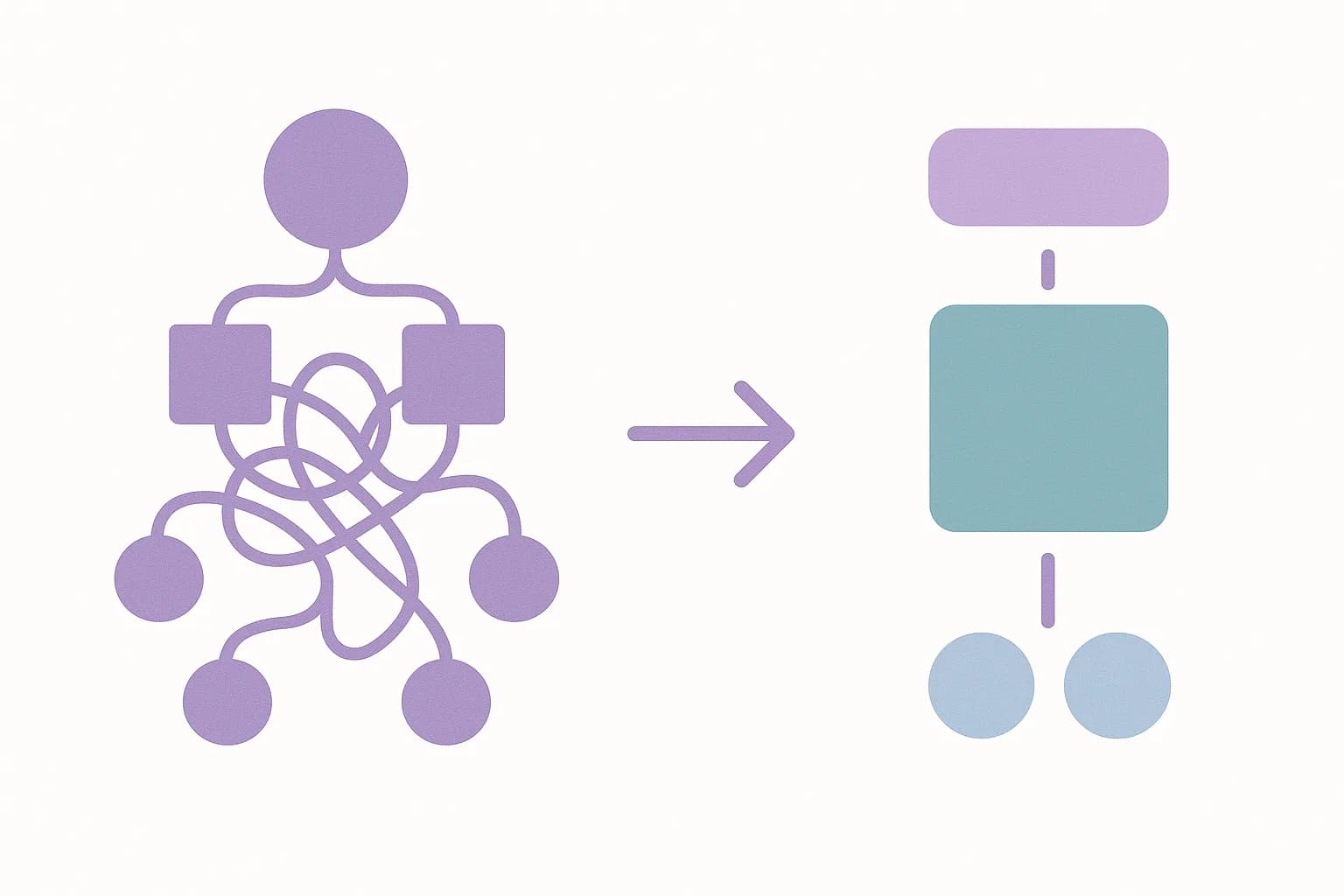
Top Headless CMS 2026: Best Picks Compared
Best headless CMS for 2026? See how seven top picks stack up on price, editing, and the risk of getting stuck with one vendor.
No single CMS wins in 2026. Pick Contentful for scale. Pick Sanity for code-based schemas. Pick Strapi to self-host. Pick Storyblok for visual editing. Pick plain MDX, like Draftbase, when content freedom matters most.
The best headless CMS for 2026 depends on one thing first: who writes the content, and who reads it back out. A marketing team needs visual editing. A React team needs typed content and a fast API. No single platform wins on both.
This guide compares the platforms developers actually shortlist this year: Contentful, Sanity, Hygraph, Strapi, Storyblok, and Cosmic. Each gets a section with real pricing, pros, and cons. It also covers a cost most comparisons skip. How your content gets stored, and what that costs you the day you want to leave. Draftbase, the CMS behind this post, takes the plain-MDX route on that exact question. It shows up throughout as a working example, not just a footnote pick.
What "Headless" Still Means in 2026
A headless CMS splits content storage from content display. You manage entries through an API. Your frontend, in React, Next.js, or anything else, fetches that content and renders it its own way.
That split used to be the whole pitch. In 2026, it's table stakes. The real differences show up in three places: how the editor works, how the API is shaped, and how content gets stored under the hood. The same split is why a headless CMS also feeds native mobile apps the same managed content it feeds the web — no separate mobile-only endpoint to stand up, since every platform pulls from the same API.
AI tooling has also become a baseline expectation, not a bonus feature. Auto-tagging, content suggestions, and AI-assisted drafting are moving from "nice to have" to expected. That's per Cosmic's own 2026 comparison.
If you're still deciding whether to go headless at all, start with headless CMS vs traditional CMS. This post assumes the decision is made.
Headless CMS Comparison: The Short Version
Here's the whole field at a glance. Storage format is the column most comparisons leave out, and the one that costs the most to get wrong. Most platforms compared here support both REST and GraphQL APIs, so query style rarely narrows the shortlist on its own — storage format and pricing usually decide it instead.
| Platform | Free tier | Lowest paid tier | Rich text stored as | Self-host | Best for |
|---|---|---|---|---|---|
| Contentful | Yes, limited | $300/mo (Lite) | Proprietary JSON (Rich Text) | No | Enterprise scale, many teams |
| Sanity | Yes, 20 seats | $15/seat/mo (Growth) | Proprietary JSON (Portable Text) | No | Schema-as-code developer teams |
| Hygraph | Yes, 3 seats | $199/mo (Growth) | GraphQL-native structured content | No | Multi-channel content federation |
| Strapi | Yes, self-hosted | $35/mo (Cloud Starter) | Blocks JSON, in your own database | Yes | Full control, no vendor bill |
| Storyblok | Yes, 1 seat | $99/mo (Growth) | Structured JSON, needs a resolver | No | Marketing teams, visual editing |
| Cosmic | Yes, 2 seats | $49/mo (Builder) | HTML | No | Small teams wanting AI features |
| Draftbase | Yes (Hobby) | $49/mo (Startup) | Plain MDX string | No | React/Next.js teams, MDX-first |
Now the pricing detail, since list price and real price rarely match.
| Platform | Plan | Price/mo | Seats | API requests/mo |
|---|---|---|---|---|
| Contentful | Lite | $300 | Included, capped | Capped, tier-based |
| Sanity | Growth | $15/seat | Up to 50 | 1M CDN, 250k uncached |
| Hygraph | Growth | $199 | 10 | 1M |
| Strapi | Community (self-hosted) | $0 | Unlimited | Unlimited |
| Strapi | Cloud Pro | $90 | No seat cap | 1M |
| Storyblok | Growth | $99 | 5, then +$15 each | 1M |
| Cosmic | Team | $299 | 5 | 25k uncached |
| Draftbase | Startup | $49 | 10 | Rate-limited, not metered |
Pricing pulled from each vendor's own pricing page. Verify before you sign, since tiers move.
Contentful: The Enterprise Default
Contentful is what large organizations end up on. It handles huge content volumes, many locales, and complex permission structures without complaint. It's also the platform most likely to appear in an RFP your procurement team already wrote.
That scale carries a real price. Contentful jumps from a limited free tier straight to $300 a month for its Lite plan, then custom pricing above that. There's no $30 middle step. See Contentful's pricing page for current tiers.
Pros
- Proven at enterprise content volume and team size.
- Deep localization support across many locales.
- Large ecosystem of apps, integrations, and agency expertise.
- Mature roles and permissions for big editorial teams.
Cons
- The free-to-paid jump is the steepest in this comparison.
- Rich text stored as a proprietary JSON tree, so migration means writing a converter.
- Content modeling lives in a dashboard, not in your repo.
- Feature gating pushes growing teams toward custom-priced tiers.
Verdict: pick Contentful when the org is big enough that the $300 floor is noise, and localization depth matters more than portability.
Sanity: Schema as Code
Sanity is the developer's pick in this field. Content models live in your repo as schema files. Queries use GROQ, its own query language, which is powerful and unlike anything else you know.
Pricing is where Sanity gets interesting. The free tier includes 20 seats, 10,000 documents, and 1M API CDN requests a month. Growth runs $15 per seat a month with 25,000 documents. Past those caps, you pay overages: $1 per 250k CDN requests, $1 per 25k API requests, and $0.30 per GB of bandwidth. Numbers from Sanity's pricing page.
Pros
- Content models are code, so schema changes review in a pull request.
- Unusually generous free tier at 20 seats.
- Sanity Studio is customizable React, not a locked dashboard.
- GROQ handles complex content queries other APIs can't express.
Cons
- Usage-based overages mean a traffic spike becomes an invoice surprise.
- GROQ is a real learning curve with no transferable value elsewhere.
- Portable Text is proprietary JSON, so exit costs a transform step.
- Per-seat pricing punishes teams with many occasional editors.
Verdict: pick Sanity when your team wants schema in version control and will absorb GROQ. Model your traffic against those overage rates first.
Hygraph: GraphQL-Native Content Platform
Hygraph is built around structured content and a native GraphQL API. Instead of treating content as pages, it models content as reusable entities and relationships that can be delivered across websites, apps, products, and other digital channels. Its standout feature is Content Federation, which lets teams connect external GraphQL or REST APIs and query that data alongside CMS content through a single GraphQL endpoint.
Pricing starts with a free Hobby plan that includes 3 seats, 1,000 content entries, 500,000 API calls, two locales, and unlimited asset storage. Growth starts at $199 per month and includes 10 seats, 10,000 entries, 1 million API calls, three locales, and the ability to connect a remote source. Enterprise pricing is custom and adds higher limits, custom workflows, advanced permissions, SSO, audit logs, dedicated infrastructure, and SLAs. Growth-plan overages are charged based on additional API operations and asset traffic.
Pros
- Native GraphQL API makes complex structured content relationships straightforward to query.
- Content Federation can combine CMS content with external REST or GraphQL sources through one API without migrating the underlying data.
- Strong fit for multi-channel and multi-brand architectures where content needs to be reused across different frontends.
- Enterprise governance includes granular permissions, custom workflows, audit logs, SSO, and extended version retention.
Cons
- GraphQL-first architecture introduces a learning curve for teams without GraphQL experience.
- More infrastructure than a simple website or small content project may need.
- Growth starts at $199/month, creating a sizeable jump from the free plan.
- It does not provide the traditional drag-and-drop page-building experience some marketing teams expect from website-focused CMS platforms.
Verdict: pick Hygraph when structured content, GraphQL, and connecting content from multiple systems are central to your architecture. It makes the most sense for teams building composable, multi-channel experiences rather than a conventional page-based website.
Strapi: Self-Host and Own It
Strapi is the open-source option, MIT-licensed, with 72,833 GitHub stars as of August 2026. The Community edition is free forever and includes unlimited entries and unlimited API calls, plus REST and GraphQL out of the box.
The catch is operational, not financial. You run the servers, the database, the backups, and the upgrades. Managed Strapi Cloud runs $35 a month (Starter, 100k API requests), $90 (Pro, 1M), or $450 (Business, 10M). SSO, audit logs, and review workflows are Enterprise-only, per Strapi's self-hosted pricing.
Pros
- Genuinely free and open-source under MIT, no seat tax.
- Unlimited entries and API calls when self-hosted.
- Your content sits in your own database, the strongest exit story here.
- REST and GraphQL both included, no upsell.
Cons
- You own uptime, backups, and version upgrades.
- SSO, audit logs, and review workflows require Enterprise licensing.
- Self-hosting cost is real, just paid in engineering hours instead of invoices.
- Plugin quality varies across the community ecosystem.
Verdict: pick Strapi when you have someone who wants to run infrastructure and you want no vendor between you and your data.
Storyblok: Visual Editing First
Storyblok's differentiator is in-context editing. An editor clicks a heading on the live page and types. No guessing how a form field maps to the rendered result. Editors can also drag and drop content blocks to reorder a page without touching code. For a marketing team shipping landing pages weekly, that alone can decide the choice.
The free tier gives 1 seat, 100k API requests, and 100GB traffic. Growth is $99 a month with 5 seats and 1M requests. Growth Plus is $349 with 15 seats and 4M requests. Extra seats cost $15 each. GraphQL and SSO both sit behind the custom-priced Premium tier, per Storyblok's pricing page.
Pros
- Best in-context visual editing in this comparison, with live preview so what an editor sees while writing is what ships.
- Component-based content blocks map cleanly to React components.
- Predictable published pricing up through Growth Plus.
- Strong locale support on higher tiers, plus real-time collaboration for editors working the same page together.
Cons
- GraphQL requires the custom-priced Premium tier.
- Free tier is a single seat, so team evaluation means paying.
- Per-seat add-ons stack up fast on Growth.
- Richtext comes back as structured JSON, so you render it through the
@storyblok/richtextpackage.
Verdict: pick Storyblok when non-technical editors own the content and want to see the page while writing.
Cosmic: Small, AI-Forward, Predictable
Cosmic is the lightweight, developer-friendly option, leaning hard into AI features. Its tiers are simple: Free (2 seats, 1,000 objects), Builder $49 (3 seats, 5,000 objects), Team $299 (5 seats, 20,000 objects), Business $499 (10 seats, 50,000 objects). Numbers from Cosmic's pricing page.
Watch the API request caps. The Team plan at $299 a month includes 25,000 non-cached API requests. That's a low ceiling if your app isn't aggressively cached.
Pros
- Simple, published tiers with no sales call.
- AI features included rather than bolted on.
- Content returned as HTML, not a custom AST.
- Fast setup for a small team.
Cons
- Non-cached API request caps are low relative to price.
- Object limits bite before seat limits do.
- Smaller ecosystem than Contentful or Strapi.
- Free tier is 2 seats, so team trials are short.
Verdict: pick Cosmic for a small team that wants AI drafting built in and caches its frontend properly.
Draftbase: MDX Without the Conversion Step
Draftbase is ours, so read this section knowing that. It's a hosted headless CMS built for React and Next.js teams, with two things the others don't have: rich text stored as plain MDX, and a native MCP server so AI agents can do everything the dashboard can.
Plans run Hobby (free), Startup $49/mo, Growth $299/mo, Scale $499/mo, and Enterprise custom. Full detail on the pricing page, no form required to see a number.
Pros
- Rich text is a plain MDX string, so there's no AST to convert on the way out.
- MDX components take typed props and render through
@draftbase/renderer. - REST and GraphQL delivery on every plan, plus a typed SDK with codegen.
- A 26-tool MCP server, so agents read and write content directly.
- Environments with sync, revision history with rollback, and semantic search.
Cons
- No in-context visual editor, so a marketing-led team should look at Storyblok.
- Younger platform than Contentful or Strapi, with a smaller ecosystem.
- Hosted only, no self-hosted edition.
- MDX-first design fits React teams better than everyone else.
Verdict: pick Draftbase when your team is React-first and content portability matters as much as the editor.
Content Modeling: Structure Now, or Structure Later
A content type defines the shape of an entry. It lists the fields, and the type each field holds. Contentful, Strapi, and Storyblok all use a form-based model builder. You add fields, pick types, and the CMS generates a schema behind the scenes.
Sanity is the outlier here. Content models live in code, as schema.ts files in your repo. That's more setup work upfront. It also means your content model reviews the same way your application code does, through a pull request.
For a React team, that code-first model has a real appeal. A schema is a contract. Contracts belong in version control. They shouldn't sit buried in a dashboard only one person remembers how to change. That's the same instinct behind designing a REST API for a headless CMS.
Form-based builders trade that rigor for speed. A non-developer can add a field in Contentful or Strapi without touching a pull request. That's the right tradeoff for a team where content modeling changes weekly. It's the wrong one for a team that wants every schema change reviewed like code. Whichever builder you use, the goal is the same: structure content once, with flexible content modeling that lets a field set adapt per content type, so a blog post and a product page don't share a rigid template neither one needs. The result is managed content that stays consistent across every page that pulls it, instead of copy duplicated by hand.
The Underused Angle: Where Your Rich Text Actually Lives
Most 2026 comparisons stop at editor UI and pricing tiers. Few ask what format your body content is actually stored in, and what that means the day you migrate.
Contentful and Sanity don't store rich text as HTML or Markdown. They store it as a proprietary JSON tree. Contentful calls its version Rich Text. Sanity calls its version Portable Text. Both encode structure, headings, links, bold spans, as nested JSON nodes specific to that vendor.
That choice isn't free. Vendor lock-in in a headless CMS is quieter than in a legacy platform. It shows up in custom field types with no clean export path. It shows up in rich text stored as a vendor-specific AST, one that needs a real transform step to leave.
Migrating a Contentful or Sanity site means writing a converter: JSON tree in, HTML or Markdown out, by hand, field by field. Teams that budget for "an export and a script" often end up closer to a partial rebuild once rich text is in scope.
Draftbase, and a growing slice of newer CMS options, take a different route. Store rich text as a plain MDX or Markdown string, full stop. No custom AST. No node-walker to write on your way out. A richText field in Draftbase is exactly the MDX your React app would render anyway. It renders server-side via @draftbase/renderer, which compiles MDX with @mdx-js/mdx and supports GFM tables and autolinks out of the box, no extra config.
That plain-text storage isn't just an exit strategy. It's also what makes content readable by an LLM with zero preprocessing, a growing requirement now that AI agents read and write content alongside people. See what an API call actually is for that request shape. The client might be a browser. Increasingly, it's an AI agent instead.
Best Headless CMS for React
For a React or Next.js app, the field narrows fast. Rank the shortlist by what the body field returns, because that decides how much rendering code your team ends up owning.
Contentful ships @contentful/rich-text-react-renderer. Sanity ships @portabletext/react. Hygraph returns structured JSON you map to components yourself. Storyblok ships @storyblok/richtext. Each maps a vendor JSON tree onto components, and each one grows a new case every time an editor asks for a block type you haven't handled yet. Strapi's Markdown field avoids that; its Blocks field doesn't.
Draftbase stores the field as MDX, so one <MDXContent> call renders an entry and your own components can sit inline in the content. Storyblok is still the better answer when editors need to see the page while they write. For the rest of the React-side detail, see the React CMS comparison.
Which Headless CMS Costs the Least?
List price is the least useful number in a headless CMS comparison. Watch three things instead. Seat-based fees that grow with your team. API call caps that turn a traffic spike into an overage bill. Features gated behind an enterprise tier you didn't expect to need.
Strapi Community is the cheapest on paper at $0, and you pay in server time instead. Among hosted options, Sanity Growth starts lowest at $15 per seat, until overages land. Draftbase Startup at $49 and Cosmic Builder at $49 tie for the lowest flat hosted tier. Storyblok Growth is $99. Hygraph Growth is $199. Contentful Lite is $300.
Run the math against your actual team size and traffic. Don't use the platform's example pricing page. A five-person team on Contentful's Lite tier pays a very different bill than a solo developer on Strapi Community.
Ask two more questions before you sign anything. First, what happens past your plan's API call limit? Some platforms throttle. Others bill per extra call, with no warning until the invoice arrives. Second, is the enterprise tier gating a real feature you'll need, like SSO or audit logs? Or is it just a higher seat count with a new name?
How to Actually Decide
Match the platform to who's doing the writing, not just who's doing the coding:
- Marketing-led team, non-technical editors: Storyblok, for in-context visual editing.
- Enterprise scale, many locales and teams: Contentful, if the budget supports it.
- Developer team that wants schema-as-code: Sanity, accepting GROQ's learning curve.
- Multi-channel, GraphQL-first, composable architecture: Hygraph, for content federation across systems.
- Full control, no vendor bill: Strapi, if you're ready to run infrastructure.
- Small team that wants AI drafting built in: Cosmic, with caching in place.
- Lightweight, MDX-native, React-first: Draftbase, if portability and AI-readability matter as much as the editor UI.
None of these is wrong. They're built for different failure modes. Pick the one whose failure mode you can actually live with in two years, not just the one with the best demo today.
Conclusion
The best headless CMS in 2026 isn't the one with the longest feature list. It's the one that matches how your team actually writes and ships content, and doesn't trap that content in a format only it understands. Check the editor experience. Check the real pricing at your scale. Check what happens to your rich text on the way out.
If your team is React-first and that last check matters most, Draftbase is built around exactly that answer. Rich text stored as plain MDX. No proprietary AST. No conversion step on your way out. Start free on Hobby, or run a team on Startup at $49/mo. See the pricing, or read how its CMS delivery API is designed for the API side of this decision.
Ship content that's built to be found
Draftbase generates schema, structured data, and a fast MDX editor for every post.
Frequently asked questions
What is the best headless CMS for 2026?
There's no single winner. Contentful fits enterprise scale. Sanity fits teams that want code-based schemas. Strapi fits teams that want to self-host for free. Draftbase fits React teams that want content stored as plain MDX.
What is the cheapest headless CMS?
Strapi Community. It's free and open-source under the MIT license, with unlimited entries and API calls, but you pay in server time since you host it yourself.
How much does a hosted headless CMS cost per month?
Entry paid tiers in 2026 run from $15 per seat on Sanity Growth, to $49 on Draftbase Startup and Cosmic Builder, $99 on Storyblok Growth, and $300 on Contentful Lite.
Is Contentful or Sanity better for developers?
Sanity, if your team wants content models in code. It uses schema files. You can check those in a pull request. Contentful uses a dashboard instead.
Which headless CMS has the best free tier?
Sanity, on seat count. Its free plan includes 20 seats, 10,000 documents, and 1M API CDN requests a month. Storyblok's free plan gives only 1 seat, and Cosmic's gives 2.
Does headless CMS choice affect vendor lock-in?
Yes. Contentful and Sanity store rich text as their own JSON format. Moving that content to another CMS takes real work to convert. A plain export won't do it.
Which headless CMS is easiest to migrate away from?
The ones that store rich text as plain text. Draftbase stores it as an MDX string and Cosmic returns HTML, so neither needs a custom converter. Self-hosted Strapi keeps the data in your own database.
Should I pick per-seat or usage-based CMS pricing?
Per-seat pricing is predictable and scales with headcount. Usage-based pricing, like Sanity's $1 per 250k CDN requests, stays cheap until traffic spikes. Pick per-seat if your traffic is volatile.
Is a headless CMS good for a React or Next.js app?
Yes. Most headless CMS platforms serve content over a REST or GraphQL API that any React app can call. Some, like Draftbase, store content as plain MDX, which a React app can render with no conversion step.
What is the best headless CMS for enterprise?
Contentful is the default enterprise pick — proven at large content volumes, deep localization, and mature roles/permissions for big editorial teams. The tradeoff is the $300/mo pricing floor and rich text stored as a proprietary JSON tree. See the Contentful section above for the full breakdown.
Samer is a software engineer and entrepreneur, founder of Draftbase and Ezi Home Services, building technology that simplifies home services. Passionate about software, APIs, automation, and creating products that solve real-world problems.